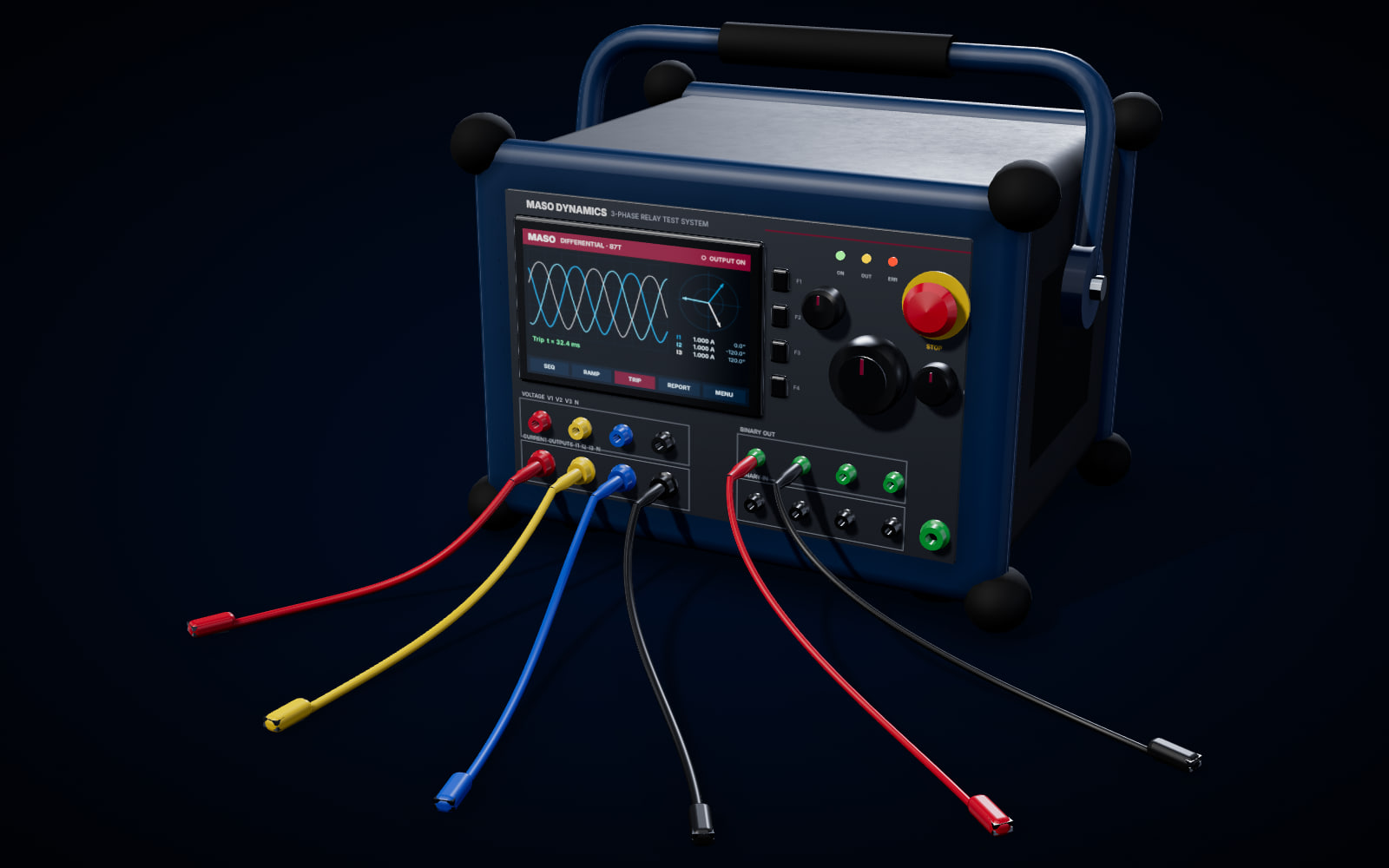
Protection earns trust only when the whole chain is proven: instrument transformer, wiring, relay logic, communications and breaker. We test relays and schemes from secondary injection through to end-to-end trials, then verify the automation, SCADA and interlocking that operators depend on.
Bay & station interlocking logic (electrical and mechanical)
Local / remote / supervisory mode transfers
HMI displays, alarm lists & event logs
Metering, BMS & PLC I/O
Revenue and check metering, plus the building and process controllers that run MEP systems.
Energy meter accuracy verification by secondary injection
Meter CT/VT ratio programming & wiring check
Multifunction meter & power analyser parameters
AMR communication & data logging
BMS point-to-point I/O checks (DI, DO, AI, AO)
Sensor & actuator calibration checks
PLC logic, sequences & alarm verification
Graphics, trends & third-party system integration
Standards
Standards
IEC 60255Measuring relays and protection equipment
IEC 60255-151Functional requirements for over/under-current protection
IEEE C37.233Guide for power system protection testing
IEC 61850Communication networks and systems for power utility automation
IEC 61869-2Additional requirements for current transformers
IEC 60870-5-104Telecontrol protocol over TCP/IP networks
IEEE 1815 (DNP3)Electric power systems communications protocol
IEC 62053-22Static meters for active energy (classes 0.1S, 0.2S, 0.5S)
ANSI/NETA ATSAcceptance testing of protective relays and systems
What you receive
What you receive
Relay test reports with as-left settings
Scheme & end-to-end test records
Secondary circuit & primary injection records
IEC 61850 signal & GOOSE verification matrix
SCADA point-to-point & interlocking checklists
Final settings & configuration file archive
FAQ
Questions, answered
What is the difference between secondary injection and end-to-end testing?
Secondary injection proves a relay's elements, settings and timing in isolation by injecting currents and voltages at its terminals. End-to-end testing proves the complete scheme — relays at both ends of a line, teleprotection and communications — with synchronized test sets simulating the same fault at each end.
Why is primary injection still needed if the relays are tested?
Relay testing does not prove the CTs, their ratio and polarity, or the wiring between them and the relay. Primary injection drives current through the primary circuit so the whole measurement chain, including differential stability, is verified before energization.
Can you test IEC 61850 systems from different vendors?
Yes. We work from the SCD file and the functional specification, verifying GOOSE and MMS signals, interlocking and time synchronization independently of the IED vendor. Testing works directly from the IEC 61850 configuration files rather than relying on vendor tools alone.
Do you review protection settings, or only test them?
Our core service is testing settings as issued and confirming they are applied correctly. Where the scope includes it, we also review settings and coordination for consistency with the design and raise any concerns with the responsible protection engineer.